|
. |
|
TYPES OF STARS (Con't) OPENING
QUESTIONS: Review our
mnemonic for the color categories of stars
Oh Be A Fine Goat, Kick Me Take a few moments to quiz each other (especially on temperatures) OBJECTIVE: I will be able to describe the conditions inside a star's core after today's class. WORD FOR TODAY:
WORK O' THE DAY: Color and temperature very definitely go together....but that's not all! Abundance (how man of those types of stars exist in the Universe) and life span and how the star dies all go together too:
We need to be careful, however, that although size often works with that chart, it doesn't always.... we'll review that tomorrow when we talk about H-R diagrams. ═══════════════════════════ Sun Song - Do - Re - Mi.... let's belt it out! What are the key conditions (according to the song) required for nuclear fusion to occur? Although I'm just fine with you remembering the sun is a mass of incandescent gas (like in a glowing neon tube in a restaurant 'cafe' sign), the correct term is 'plasma'. If you understand that, YAY!, if you are more comfy with the sun being a mass of incandescent gas I'm fine with that! Here's what it's all about
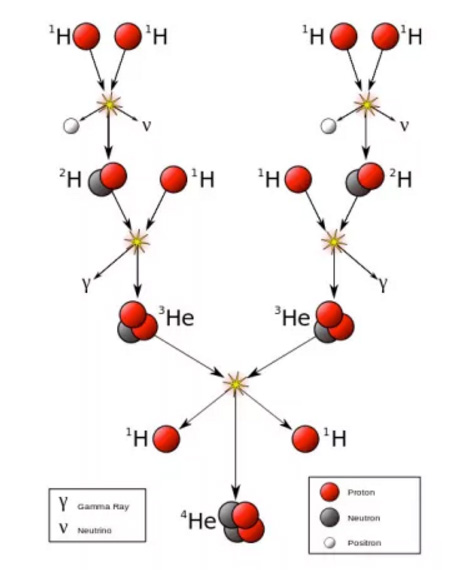
═══════════════════════════ Let's investigate further how atoms 'smash' together. I'll pass out a couple of magnets, flip them over so both are positive side up. Now push them together. The similar magnetic force pushes them apart. Imaging a force millions of times stronger than that the keeps positively pulling protons apart. How is it that those positively pulling protons end up mashing together? Let's discuss! Here is a fairly basic way to understand how hydrogen nuclei (protons!) mash together to form helium nuclei (Do you notice anything ODD going on here?.)  What about THIS? 
Here is a more exhaustive (and also more confusing) explanation of the tortured path that protons go through to go from hydrogen nuclei to helium nuclei. You don't need to know that but if you like to nerd out on such things then by all means go for it!!!
═════════════════════════════════════════════
|